
Vérification de la limite d’âge de ce jeu…
Warriors of Fate
À propos du jeu
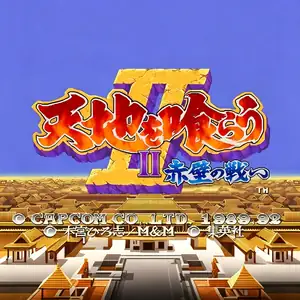
Tenchi wo Kurau II: Sekiheki no Tatakai, internationally titled Warriors of Fate and widely known as Sangokushi 2 among Chinese‑speaking players, is a CPS‑1 side‑scrolling beat‑'em‑up released by Capcom in 1992. Based on Hiroshi Motomiya’s manga Tenchi wo Kurau, it is the peak sequel in the Tenchi wo Kurau franchise and one of the most legendary Three‑Kingdoms‑themed arcade games. The campaign starts from the Battle of Bowang Slope and leads through the Battle of Red Cliff, depicting Liu Bei’s generals fighting against Cao Cao’s forces. Up to three players can join co‑op gameplay, choosing from five distinct heroes: Guan Yu, Zhang Fei, Zhao Yun, Huang Zhong and Wei Yan, each with unique stats and special moves. Moving away from the mount‑focused combat of the first game, infantry‑style brawling takes center stage. The system features combos, throws, aerial grabs and health‑costing special attacks. Players can pick up swords, spears, maces and rare secret weapons such as Yitian and Holy Sword. Food items hidden inside destructible crates restore health, while horse‑mounted combat remains available. Across nine stages, players fight powerful Wei generals including Li Dian, Xiahou Dun, Xu Chu and Zhang Liao. Praised for its satisfying combat and striking manga‑style visuals, the arcade original can be experienced via MAME emulators. It was later ported to PlayStation and Sega Saturn, and remains an iconic landmark of beat‑'em‑up arcade history.
- Année de sortie
- 1992
- Développeur
- Joueurs
- 3 joueurs
- Langues prises en charge
- 简体中文 · English · 日本語
FAQ
- Comment jouer à Warriors of Fate ?
- Vous pouvez jouer à Warriors of Fate en ligne et gratuitement directement dans votre navigateur sur 8BitGo. Aucun téléchargement ni installation d'émulateur n'est nécessaire.
- Sur quelle plateforme est Warriors of Fate ?
- 8BitGo classe cette version dans la catégorie Arcade. Cela décrit son mode d'exécution ici et peut différer de la plateforme de sortie d'origine. Vous pouvez jouer directement dans le navigateur.
- Puis-je sauvegarder ma progression dans Warriors of Fate ?
- La sauvegarde dépend du mode d'exécution du jeu. Les sauvegardes rapides et cloud ne sont disponibles que si la barre du lecteur affiche une commande de sauvegarde ; sinon, utilisez la sauvegarde intégrée au jeu.
- Warriors of Fate fonctionne-t-il sur mobile ?
- Cela dépend du jeu. Consultez les commandes sur cette page : les jeux avec boutons à l'écran fonctionnent au tactile, tandis que les jeux au clavier et à la souris sont mieux adaptés à un ordinateur.
Commandes
Voici les touches par défaut. Chaque carte d’arcade a un nombre de boutons différent et leur donne un sens différent. Les lignes ci-dessus sont les boutons 1 à 6 de la carte : sur Neo Geo (The King of Fighters et compagnie) A/B/C/D sont les boutons 1 à 4, Metal Slug n’utilise que 1, 2 et 4 (tir / saut / grenade), et Pac-Man n’en utilise aucun. Les jeux de combat à six boutons (trois poings, trois pieds — Street Fighter II par exemple) reçoivent une autre disposition du cœur : poing faible U, poing moyen I, poing fort Q, pied faible J, pied moyen K, pied fort E. Cliquez sur l’icône de manette 🎮 dans la barre du lecteur, puis sur « Redéfinir les touches » pour ouvrir les réglages de commandes de l’émulateur (clavier et manette, enregistrés automatiquement). Les manettes sont détectées automatiquement. Sur téléphone, des boutons virtuels s’affichent.
Croix directionnelle
W S A D
Bouton 1
J
Bouton 2
K
Bouton 3
U
Bouton 4
I
Bouton 5
E
Bouton 6
Q
Insérer une pièce
V
Start
Enter
Sauvegarde rapide
F2
Chargement rapide
F4
Tu aimeras peut-être aussi
Même plateforme, même genre, ou même développeur
Cadillacs and Dinosaurs
 ARCADE
JoJo's Bizarre Adventure: Heritage for the Future
 ARCADE
Marvel Super Heroes vs Street Fighter
 ARCADE
Street Fighter Alpha 3
.webp) ARCADE
ARCADESuper Street Fighter II Turbo
 GBA
GBAPhoenix Wright: Ace Attorney
 ARCADE
Street Fighter
 GB
GB