
Checking this game’s age requirement…
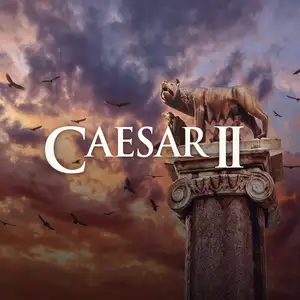
Caesar II
About this game
Caesar II is an ancient Roman city-building simulation developed by Impressions Games and published by Sierra On-Line, released for MS-DOS in 1995. It is the second entry of the Caesar franchise, greatly upgrading graphics and gameplay over the original Caesar 1. Players act as Roman provincial governors. Your goal is to govern provinces, build prosperous cities, gain the emperor’s favor, climb the ranks, and ultimately become Caesar. It retains the two-map system: province overworld and city detail view. On the province map, you build farms, mines, ports and forts, establish trade routes and manage resource production and border defense. Inside the city, construct housing, aqueducts, bathhouses, markets, temples and amphitheaters. Unlike Caesar III, it does not use walker mechanics; service coverage is calculated purely by building distance. Cities are evaluated by four key metrics: population, food supply, taxation, security and cultural prosperity. You must complete imperial assignments and tribute requests from the emperor. A new AI rival competes with you for provinces and imperial approval, seizing undeveloped lands and adding competitive pressure. Barbarian armies launch raids from their settlements. Build city walls and forts, recruit Roman legions and fight in standalone tactical battles to defend your territory. As provinces are civilized, new territories unlock. Your campaign begins in Italy and expands to the full extent of the Roman Empire. It uses isometric graphics built from pre-rendered 3D assets with vastly improved building details and majestic soundtrack, supporting Sound Blaster audio. The game is single-player campaign only, with no free sandbox mode. It refined the predecessor’s three-in-one gameplay loop combining city construction, provincial management and tactical warfare, laying the foundation for Caesar III. Modern players run it with DOSBox emulator. It is a landmark historical strategy simulation DOS title of the 1990s.
- Release year
- 1990
- Developer
- Players
- Single player
- Supported languages
- English
FAQ
- How can I play Caesar II?
- You can play Caesar II online for free right in your browser on 8BitGo. No download or emulator installation is required.
- What platform is Caesar II?
- 8BitGo classifies this version as DOS PC Games. That describes how it runs here and may differ from the game's original release platform. You can play it directly in the browser.
- Can I save my progress in Caesar II?
- Save support depends on how this game runs. Quick saves and cloud saves are available only when the player toolbar shows a save control; otherwise use the game's own save feature.
- Does Caesar II work on mobile?
- It depends on the game. Check the controls on this page: games with on-screen buttons work on touch devices, while keyboard-and-mouse games are best played on desktop.
Controls
These games get the keyboard directly — the controls are whatever the game itself defines, usually in its own help or options screen. Gamepads are detected automatically. On phones you get on-screen buttons.
You might also like
Same platform, same genre, or from the same developer
 DOS
DOSAge of Empires
 NES
NESSuper Mario Bros.3
 NDS
NDSPlants vs. Zombies
 NES
NESCircus Charlie
 NES
NESGomoku Narabe Renju
 NDS
NDSGrand Theft Auto: Chinatown Wars
 GBA
GBAThe King of Fighters EX: Neo Blood
 ARCADE