
Comprobando el requisito de edad de este juego…
Sobre este juego
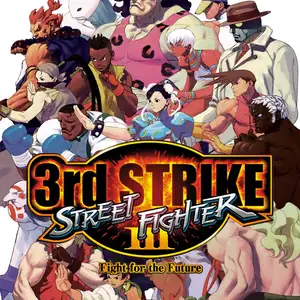
Street Fighter III: 3rd Strike - Fight for the Future (commonly shortened to 3rd Strike or SF3.3) is an arcade fighting game released by Capcom in 1999. It is the final entry of the Street Fighter III trilogy and runs on the CP System III arcade board. Five new fighters were added: Chun-Li, Makoto, Remy, Q and Twelve, expanding the total playable roster to 20 characters. Shin Akuma from the previous version was removed. The game retains the franchise’s famous Parry system and introduces the new Guard Parry (Red Parry), allowing players to parry incoming attacks even during block stun. It keeps core mechanics including selectable Super Arts, EX special moves and tech throws. A post-match grading system evaluates players on offense, defense and technical skill. The classic car-destroying bonus stage also returns, with extensive rebalancing of move frames and character performance. The hand-drawn CPS3 sprite animations remain widely regarded as the peak of 2D fighting game visuals. This title gave birth to the legendary EVO Moment 37, the famous Daigo Umehara parry comeback. Though sales were modest at launch, it earned a massive competitive fanbase due to its deep gameplay and is still featured in fighting game tournaments. It was later ported to Dreamcast, PS2 and Xbox, received an Online Edition, and was included in the Street Fighter 30th Anniversary Collection, standing as a legendary title among hardcore fighting game fans.
- Año de lanzamiento
- 1990
- Desarrolladora
- Jugadores
- 1 jugador
- Idiomas compatibles
- English
Preguntas frecuentes
- ¿Cómo puedo jugar a Street Fighter III: 3rd Strike - Fight for the Future?
- Puedes jugar a Street Fighter III: 3rd Strike - Fight for the Future en línea y gratis directamente en tu navegador en 8BitGo. No necesitas descargar nada ni instalar ningún emulador.
- ¿En qué plataforma es Street Fighter III: 3rd Strike - Fight for the Future?
- 8BitGo clasifica esta versión como Arcade. Esto describe cómo se ejecuta aquí y puede diferir de la plataforma de lanzamiento original. Puedes jugar directamente en el navegador.
- ¿Puedo guardar mi progreso en Street Fighter III: 3rd Strike - Fight for the Future?
- La posibilidad de guardar depende de cómo se ejecute el juego. El guardado rápido y en la nube solo está disponible si la barra del reproductor muestra un control de guardado; si no, usa el guardado propio del juego.
- ¿Funciona Street Fighter III: 3rd Strike - Fight for the Future en el móvil?
- Depende del juego. Consulta los controles de esta página: los juegos con botones en pantalla funcionan con tacto, mientras que los de teclado y ratón se disfrutan mejor en un ordenador.
Controles
Estas son las teclas predeterminadas. Cada placa recreativa tiene un número de botones distinto y les da un sentido distinto. Arriba están los botones 1 a 6 de la placa: en Neo Geo (The King of Fighters y compañía) A/B/C/D son los botones 1 a 4, Metal Slug solo usa 1, 2 y 4 (disparo / salto / granada), y Pac-Man no usa ninguno. Los juegos de lucha de seis botones con tres puños y tres patadas (Street Fighter II, por ejemplo) reciben otra disposición del núcleo: puño flojo U, puño medio I, puño fuerte Q, patada floja J, patada media K, patada fuerte E. Haz clic en el icono de mando 🎮 de la barra del reproductor y luego en «Reasignar teclas» para abrir la configuración de controles del emulador (teclado y mando, se guarda automáticamente). Si conectas un mando, se detecta solo. En el teléfono aparecen botones en pantalla.
Cruceta
W S A D
Botón 1
J
Botón 2
K
Botón 3
U
Botón 4
I
Botón 5
E
Botón 6
Q
Insertar moneda
V
Start
Enter
Guardado rápido
F2
Carga rápida
F4
También te puede gustar
Misma plataforma, mismo género o de la misma desarrolladora
 DOS
DOSAge of Empires
 NES
NESSuper Mario Bros.3
 NDS
NDSPlants vs. Zombies
 NES
NESCircus Charlie
 NES
NESGomoku Narabe Renju
 NDS
NDSGrand Theft Auto: Chinatown Wars
 GBA
GBAThe King of Fighters EX: Neo Blood
 ARCADE