
Comprobando el requisito de edad de este juego…
Sobre este juego
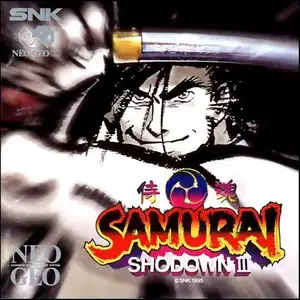
Samurai Shodown III: Blades of Blood (Japanese: Samurai Spirits Zankuro Musouken) is a weapon-based fighting game developed by SNK, released for Neo Geo MVS arcade hardware on November 15, 1995. Its timeline takes place between the first Samurai Shodown and Samurai Shodown II. The demon swordsman Minazuki Zankuro roams the land and slaughters countless warriors. The amnesiac boy Shizumaru Hisame, the new protagonist of this installment, joins other swordsmen to hunt down Zankuro. Its landmark new feature is the **Shura / Rasetsu sword alignment system**. Every character has two move sets. Shura excels in aerial combat while Rasetsu focuses on ground fighting. With only 12 selectable fighters, the dual styles effectively create 24 unique fighting profiles. Players also pick one of three combat ranks at the start: Kenshi (Swordsman) with limited auto-guard but slower rage gain; Kengo (Master Swordsman), the balanced default mode; Kensei (Sword Saint) with permanently maxed rage but **no ability to block**, for advanced players. The combat system is heavily revised. Rolls are removed and replaced with quick evasive sidesteps and back-turning attacks. New mechanics include parry counters, guard breakers and weapon-knockoff specials. The classic Rage Gauge remains; players can build rage by taking hits or manually charging it. At full rage, attack power surges. The roster shrinks to 12 characters. New fighters include Shizumaru, Rimururu, Basara, Gaira and final boss Zankuro. Returning veterans such as Haohmaru, Nakoruru, Hanzo Hattori and Ukyo Tachibana get fully redrawn animations and new moves. The art shifts to atmospheric ink-wash visuals paired with somber, ethereal soundtrack. Matches follow best-of-three rules, with random meat for HP recovery and bombs falling into the battlefield. This title drastically reworked the franchise formula and received mixed reception. It was less popular in Chinese arcades than Samurai Shodown II, but its dual-alignment and three-rank systems laid an important foundation for later entries, making it a pivotal experimental chapter in the Samurai Shodown saga.
- Año de lanzamiento
- 1990
- Desarrolladora
- Jugadores
- 2 jugadores
- Idiomas compatibles
- English
Preguntas frecuentes
- ¿Cómo puedo jugar a Samurai Shodown III: Blades of Blood?
- Puedes jugar a Samurai Shodown III: Blades of Blood en línea y gratis directamente en tu navegador en 8BitGo. No necesitas descargar nada ni instalar ningún emulador.
- ¿En qué plataforma es Samurai Shodown III: Blades of Blood?
- 8BitGo clasifica esta versión como Arcade. Esto describe cómo se ejecuta aquí y puede diferir de la plataforma de lanzamiento original. Puedes jugar directamente en el navegador.
- ¿Puedo guardar mi progreso en Samurai Shodown III: Blades of Blood?
- La posibilidad de guardar depende de cómo se ejecute el juego. El guardado rápido y en la nube solo está disponible si la barra del reproductor muestra un control de guardado; si no, usa el guardado propio del juego.
- ¿Funciona Samurai Shodown III: Blades of Blood en el móvil?
- Depende del juego. Consulta los controles de esta página: los juegos con botones en pantalla funcionan con tacto, mientras que los de teclado y ratón se disfrutan mejor en un ordenador.
Controles
Estas son las teclas predeterminadas. Cada placa recreativa tiene un número de botones distinto y les da un sentido distinto. Arriba están los botones 1 a 6 de la placa: en Neo Geo (The King of Fighters y compañía) A/B/C/D son los botones 1 a 4, Metal Slug solo usa 1, 2 y 4 (disparo / salto / granada), y Pac-Man no usa ninguno. Los juegos de lucha de seis botones con tres puños y tres patadas (Street Fighter II, por ejemplo) reciben otra disposición del núcleo: puño flojo U, puño medio I, puño fuerte Q, patada floja J, patada media K, patada fuerte E. Haz clic en el icono de mando 🎮 de la barra del reproductor y luego en «Reasignar teclas» para abrir la configuración de controles del emulador (teclado y mando, se guarda automáticamente). Si conectas un mando, se detecta solo. En el teléfono aparecen botones en pantalla.
Cruceta
W S A D
Botón 1
J
Botón 2
K
Botón 3
U
Botón 4
I
Botón 5
E
Botón 6
Q
Insertar moneda
V
Start
Enter
Guardado rápido
F2
Carga rápida
F4
También te puede gustar
Misma plataforma, mismo género o de la misma desarrolladora
 DOS
DOSAge of Empires
 NES
NESSuper Mario Bros.3
 NDS
NDSPlants vs. Zombies
 NES
NESCircus Charlie
 NES
NESGomoku Narabe Renju
 NDS
NDSGrand Theft Auto: Chinatown Wars
 GBA
GBAThe King of Fighters EX: Neo Blood
 ARCADE