
Vérification de la limite d’âge de ce jeu…
À propos du jeu
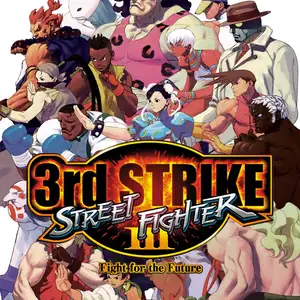
Street Fighter III: 3rd Strike - Fight for the Future (commonly shortened to 3rd Strike or SF3.3) is an arcade fighting game released by Capcom in 1999. It is the final entry of the Street Fighter III trilogy and runs on the CP System III arcade board. Five new fighters were added: Chun-Li, Makoto, Remy, Q and Twelve, expanding the total playable roster to 20 characters. Shin Akuma from the previous version was removed. The game retains the franchise’s famous Parry system and introduces the new Guard Parry (Red Parry), allowing players to parry incoming attacks even during block stun. It keeps core mechanics including selectable Super Arts, EX special moves and tech throws. A post-match grading system evaluates players on offense, defense and technical skill. The classic car-destroying bonus stage also returns, with extensive rebalancing of move frames and character performance. The hand-drawn CPS3 sprite animations remain widely regarded as the peak of 2D fighting game visuals. This title gave birth to the legendary EVO Moment 37, the famous Daigo Umehara parry comeback. Though sales were modest at launch, it earned a massive competitive fanbase due to its deep gameplay and is still featured in fighting game tournaments. It was later ported to Dreamcast, PS2 and Xbox, received an Online Edition, and was included in the Street Fighter 30th Anniversary Collection, standing as a legendary title among hardcore fighting game fans.
- Année de sortie
- 1990
- Développeur
- Joueurs
- 1 joueur
- Langues prises en charge
- English
FAQ
- Comment jouer à Street Fighter III: 3rd Strike - Fight for the Future ?
- Vous pouvez jouer à Street Fighter III: 3rd Strike - Fight for the Future en ligne et gratuitement directement dans votre navigateur sur 8BitGo. Aucun téléchargement ni installation d'émulateur n'est nécessaire.
- Sur quelle plateforme est Street Fighter III: 3rd Strike - Fight for the Future ?
- 8BitGo classe cette version dans la catégorie Arcade. Cela décrit son mode d'exécution ici et peut différer de la plateforme de sortie d'origine. Vous pouvez jouer directement dans le navigateur.
- Puis-je sauvegarder ma progression dans Street Fighter III: 3rd Strike - Fight for the Future ?
- La sauvegarde dépend du mode d'exécution du jeu. Les sauvegardes rapides et cloud ne sont disponibles que si la barre du lecteur affiche une commande de sauvegarde ; sinon, utilisez la sauvegarde intégrée au jeu.
- Street Fighter III: 3rd Strike - Fight for the Future fonctionne-t-il sur mobile ?
- Cela dépend du jeu. Consultez les commandes sur cette page : les jeux avec boutons à l'écran fonctionnent au tactile, tandis que les jeux au clavier et à la souris sont mieux adaptés à un ordinateur.
Commandes
Voici les touches par défaut. Chaque carte d’arcade a un nombre de boutons différent et leur donne un sens différent. Les lignes ci-dessus sont les boutons 1 à 6 de la carte : sur Neo Geo (The King of Fighters et compagnie) A/B/C/D sont les boutons 1 à 4, Metal Slug n’utilise que 1, 2 et 4 (tir / saut / grenade), et Pac-Man n’en utilise aucun. Les jeux de combat à six boutons (trois poings, trois pieds — Street Fighter II par exemple) reçoivent une autre disposition du cœur : poing faible U, poing moyen I, poing fort Q, pied faible J, pied moyen K, pied fort E. Cliquez sur l’icône de manette 🎮 dans la barre du lecteur, puis sur « Redéfinir les touches » pour ouvrir les réglages de commandes de l’émulateur (clavier et manette, enregistrés automatiquement). Les manettes sont détectées automatiquement. Sur téléphone, des boutons virtuels s’affichent.
Croix directionnelle
W S A D
Bouton 1
J
Bouton 2
K
Bouton 3
U
Bouton 4
I
Bouton 5
E
Bouton 6
Q
Insérer une pièce
V
Start
Enter
Sauvegarde rapide
F2
Chargement rapide
F4
Tu aimeras peut-être aussi
Même plateforme, même genre, ou même développeur
 DOS
DOSAge of Empires
 NES
NESSuper Mario Bros.3
 NDS
NDSPlants vs. Zombies
 NES
NESCircus Charlie
 NES
NESGomoku Narabe Renju
 NDS
NDSGrand Theft Auto: Chinatown Wars
 GBA
GBAThe King of Fighters EX: Neo Blood
 ARCADE