
Vérification de la limite d’âge de ce jeu…
À propos du jeu
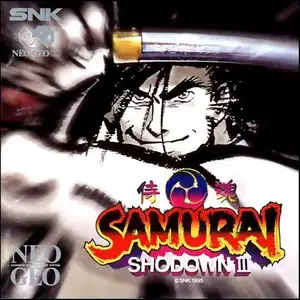
Samurai Shodown III: Blades of Blood (Japanese: Samurai Spirits Zankuro Musouken) is a weapon-based fighting game developed by SNK, released for Neo Geo MVS arcade hardware on November 15, 1995. Its timeline takes place between the first Samurai Shodown and Samurai Shodown II. The demon swordsman Minazuki Zankuro roams the land and slaughters countless warriors. The amnesiac boy Shizumaru Hisame, the new protagonist of this installment, joins other swordsmen to hunt down Zankuro. Its landmark new feature is the **Shura / Rasetsu sword alignment system**. Every character has two move sets. Shura excels in aerial combat while Rasetsu focuses on ground fighting. With only 12 selectable fighters, the dual styles effectively create 24 unique fighting profiles. Players also pick one of three combat ranks at the start: Kenshi (Swordsman) with limited auto-guard but slower rage gain; Kengo (Master Swordsman), the balanced default mode; Kensei (Sword Saint) with permanently maxed rage but **no ability to block**, for advanced players. The combat system is heavily revised. Rolls are removed and replaced with quick evasive sidesteps and back-turning attacks. New mechanics include parry counters, guard breakers and weapon-knockoff specials. The classic Rage Gauge remains; players can build rage by taking hits or manually charging it. At full rage, attack power surges. The roster shrinks to 12 characters. New fighters include Shizumaru, Rimururu, Basara, Gaira and final boss Zankuro. Returning veterans such as Haohmaru, Nakoruru, Hanzo Hattori and Ukyo Tachibana get fully redrawn animations and new moves. The art shifts to atmospheric ink-wash visuals paired with somber, ethereal soundtrack. Matches follow best-of-three rules, with random meat for HP recovery and bombs falling into the battlefield. This title drastically reworked the franchise formula and received mixed reception. It was less popular in Chinese arcades than Samurai Shodown II, but its dual-alignment and three-rank systems laid an important foundation for later entries, making it a pivotal experimental chapter in the Samurai Shodown saga.
- Année de sortie
- 1990
- Développeur
- Joueurs
- 2 joueurs
- Langues prises en charge
- English
FAQ
- Comment jouer à Samurai Shodown III: Blades of Blood ?
- Vous pouvez jouer à Samurai Shodown III: Blades of Blood en ligne et gratuitement directement dans votre navigateur sur 8BitGo. Aucun téléchargement ni installation d'émulateur n'est nécessaire.
- Sur quelle plateforme est Samurai Shodown III: Blades of Blood ?
- 8BitGo classe cette version dans la catégorie Arcade. Cela décrit son mode d'exécution ici et peut différer de la plateforme de sortie d'origine. Vous pouvez jouer directement dans le navigateur.
- Puis-je sauvegarder ma progression dans Samurai Shodown III: Blades of Blood ?
- La sauvegarde dépend du mode d'exécution du jeu. Les sauvegardes rapides et cloud ne sont disponibles que si la barre du lecteur affiche une commande de sauvegarde ; sinon, utilisez la sauvegarde intégrée au jeu.
- Samurai Shodown III: Blades of Blood fonctionne-t-il sur mobile ?
- Cela dépend du jeu. Consultez les commandes sur cette page : les jeux avec boutons à l'écran fonctionnent au tactile, tandis que les jeux au clavier et à la souris sont mieux adaptés à un ordinateur.
Commandes
Voici les touches par défaut. Chaque carte d’arcade a un nombre de boutons différent et leur donne un sens différent. Les lignes ci-dessus sont les boutons 1 à 6 de la carte : sur Neo Geo (The King of Fighters et compagnie) A/B/C/D sont les boutons 1 à 4, Metal Slug n’utilise que 1, 2 et 4 (tir / saut / grenade), et Pac-Man n’en utilise aucun. Les jeux de combat à six boutons (trois poings, trois pieds — Street Fighter II par exemple) reçoivent une autre disposition du cœur : poing faible U, poing moyen I, poing fort Q, pied faible J, pied moyen K, pied fort E. Cliquez sur l’icône de manette 🎮 dans la barre du lecteur, puis sur « Redéfinir les touches » pour ouvrir les réglages de commandes de l’émulateur (clavier et manette, enregistrés automatiquement). Les manettes sont détectées automatiquement. Sur téléphone, des boutons virtuels s’affichent.
Croix directionnelle
W S A D
Bouton 1
J
Bouton 2
K
Bouton 3
U
Bouton 4
I
Bouton 5
E
Bouton 6
Q
Insérer une pièce
V
Start
Enter
Sauvegarde rapide
F2
Chargement rapide
F4
Tu aimeras peut-être aussi
Même plateforme, même genre, ou même développeur
 DOS
DOSAge of Empires
 NES
NESSuper Mario Bros.3
 NDS
NDSPlants vs. Zombies
 NES
NESCircus Charlie
 NES
NESGomoku Narabe Renju
 NDS
NDSGrand Theft Auto: Chinatown Wars
 GBA
GBAThe King of Fighters EX: Neo Blood
 ARCADE