
Vérification de la limite d’âge de ce jeu…
À propos du jeu
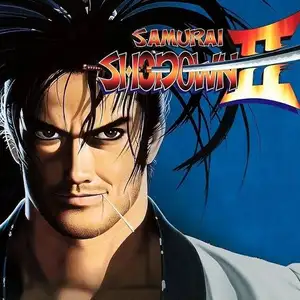
Samurai Shodown II (Japanese title Shin Samurai Spirits: Haohmaru Jigokuhen, known to Chinese players as True Samurai Shodown) is a weapon-based fighting masterpiece developed by SNK and released for Neo Geo MVS arcade hardware in 1994, widely regarded as the peak entry of the Samurai Shodown franchise. After Amakusa Shiro Tokisada’s defeat in the first game, the demon queen Mizuki Rashojin revives and plans to open the gate of the demon realm to destroy the mortal world. Haohmaru, Ukyo Tachibana and other warriors set out to stop Mizuki’s evil scheme. It inherits the signature Rage Gauge system. The gauge fills when taking damage or landing hits. When fully charged, the character turns red with drastically boosted attack power. The landmark new mechanic is the **Weapon Break special move**, usable only at max rage. A successful hit shatters the foe’s weapon, forcing them to fight unarmed with reduced attack and defense. The broken weapon can be picked up again after a short period. Compared with the first game, movement options are greatly expanded with forward roll, back roll, low crouch and low dodge, enriching offensive and defensive tactics. The roster expands to 15 fighters. Four new characters join: Genjuro Kibagami, Cham Cham, Neinhalt Sieger and Nicotine Caffeine. Returning veterans including Haohmaru, Nakoruru, Ukyo Tachibana and Hanzo Hattori receive brand-new moves. Secret commands such as chibi transformation are included. Matches follow best-of-three rules, retaining the blade clash mechanic where players mash buttons to win the weapon lock duel. It features smooth pixel animation, sharp slash visual effects and authentic blade-clashing sound effects, paired with immersive Japanese-style music. Gameplay emphasizes spacing and careful positioning rather than long combos; a single heavy slash can turn the tide of battle. It was immensely popular in Chinese arcades in the 90s and remains a beloved classic for retro fighting game enthusiasts.
- Année de sortie
- 1990
- Développeur
- Joueurs
- 2 joueurs
- Langues prises en charge
- English
FAQ
- Comment jouer à Samurai Shodown II ?
- Vous pouvez jouer à Samurai Shodown II en ligne et gratuitement directement dans votre navigateur sur 8BitGo. Aucun téléchargement ni installation d'émulateur n'est nécessaire.
- Sur quelle plateforme est Samurai Shodown II ?
- 8BitGo classe cette version dans la catégorie Arcade. Cela décrit son mode d'exécution ici et peut différer de la plateforme de sortie d'origine. Vous pouvez jouer directement dans le navigateur.
- Puis-je sauvegarder ma progression dans Samurai Shodown II ?
- La sauvegarde dépend du mode d'exécution du jeu. Les sauvegardes rapides et cloud ne sont disponibles que si la barre du lecteur affiche une commande de sauvegarde ; sinon, utilisez la sauvegarde intégrée au jeu.
- Samurai Shodown II fonctionne-t-il sur mobile ?
- Cela dépend du jeu. Consultez les commandes sur cette page : les jeux avec boutons à l'écran fonctionnent au tactile, tandis que les jeux au clavier et à la souris sont mieux adaptés à un ordinateur.
Commandes
Voici les touches par défaut. Chaque carte d’arcade a un nombre de boutons différent et leur donne un sens différent. Les lignes ci-dessus sont les boutons 1 à 6 de la carte : sur Neo Geo (The King of Fighters et compagnie) A/B/C/D sont les boutons 1 à 4, Metal Slug n’utilise que 1, 2 et 4 (tir / saut / grenade), et Pac-Man n’en utilise aucun. Les jeux de combat à six boutons (trois poings, trois pieds — Street Fighter II par exemple) reçoivent une autre disposition du cœur : poing faible U, poing moyen I, poing fort Q, pied faible J, pied moyen K, pied fort E. Cliquez sur l’icône de manette 🎮 dans la barre du lecteur, puis sur « Redéfinir les touches » pour ouvrir les réglages de commandes de l’émulateur (clavier et manette, enregistrés automatiquement). Les manettes sont détectées automatiquement. Sur téléphone, des boutons virtuels s’affichent.
Croix directionnelle
W S A D
Bouton 1
J
Bouton 2
K
Bouton 3
U
Bouton 4
I
Bouton 5
E
Bouton 6
Q
Insérer une pièce
V
Start
Enter
Sauvegarde rapide
F2
Chargement rapide
F4
Tu aimeras peut-être aussi
Même plateforme, même genre, ou même développeur
 DOS
DOSAge of Empires
 NES
NESSuper Mario Bros.3
 NDS
NDSPlants vs. Zombies
 NES
NESCircus Charlie
 NES
NESGomoku Narabe Renju
 NDS
NDSGrand Theft Auto: Chinatown Wars
 GBA
GBAThe King of Fighters EX: Neo Blood
 ARCADE