
Vérification de la limite d’âge de ce jeu…
À propos du jeu
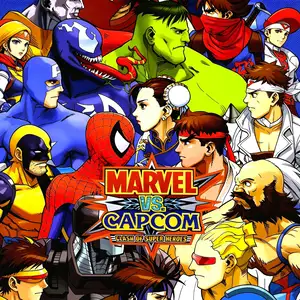
Marvel vs. Capcom: Clash of Super Heroes (MvC) is a crossover tag-team fighting game developed by Capcom, released for CPS2 arcade hardware in 1998. It is the third main title of the Marvel vs Capcom franchise, following Marvel Super Heroes vs Street Fighter. The villain Onslaught unleashes overwhelming psychic power to destroy the world. Heroes from Marvel and Capcom universes join forces to stop the catastrophe. It keeps the franchise’s signature fast aerial combo gameplay with six-button layout, super jump, air dash and air combos. Fill the super gauge to unleash devastating Hyper Combos. Its core **Special Partner assist system**: you pick one main fighter plus a random supporting partner. Summon the partner for assist attacks mid-fight. Unlike prior entries, you cannot freely switch between two main fighters. The new Duo Team Attack consumes gauge to briefly bring both characters onto the screen at once for combined offensive pressure. Playable roster gathers all-star heroes from Marvel and Capcom. Marvel side: Spider-Man, Wolverine, Captain America, Hulk, Venom, Gambit, War Machine. Capcom side: Ryu, Chun-Li, Zangief, Morrigan, Mega Man, Captain Commando, Strider Hiryu and Jin Saotome. Secret hidden characters include Gold War Machine, Hyper Venom, Orange Hulk, Roll, Shadow Lady and Lilith Morrigan. Onslaught serves as the arcade final boss. Matches follow best-of-three rules, with arcade story and versus multiplayer modes. It features vibrant comic-style pixel art and energetic soundtrack. Later ported to PlayStation and Sega Dreamcast. The Dreamcast version is a faithful high-quality port, while the PS1 release cut several assist functions. It was popular in Chinese arcades. Fast aerial combat and assist combinations deliver spectacular matches. This late-era CPS2 crossover fighter laid important groundwork for Marvel vs Capcom 2.
- Année de sortie
- 1990
- Développeur
- Joueurs
- 1 joueur
- Langues prises en charge
- English
FAQ
- Comment jouer à Marvel vs. Capcom: Clash of Super Heroes ?
- Vous pouvez jouer à Marvel vs. Capcom: Clash of Super Heroes en ligne et gratuitement directement dans votre navigateur sur 8BitGo. Aucun téléchargement ni installation d'émulateur n'est nécessaire.
- Sur quelle plateforme est Marvel vs. Capcom: Clash of Super Heroes ?
- 8BitGo classe cette version dans la catégorie Arcade. Cela décrit son mode d'exécution ici et peut différer de la plateforme de sortie d'origine. Vous pouvez jouer directement dans le navigateur.
- Puis-je sauvegarder ma progression dans Marvel vs. Capcom: Clash of Super Heroes ?
- La sauvegarde dépend du mode d'exécution du jeu. Les sauvegardes rapides et cloud ne sont disponibles que si la barre du lecteur affiche une commande de sauvegarde ; sinon, utilisez la sauvegarde intégrée au jeu.
- Marvel vs. Capcom: Clash of Super Heroes fonctionne-t-il sur mobile ?
- Cela dépend du jeu. Consultez les commandes sur cette page : les jeux avec boutons à l'écran fonctionnent au tactile, tandis que les jeux au clavier et à la souris sont mieux adaptés à un ordinateur.
Commandes
Voici les touches par défaut. Chaque carte d’arcade a un nombre de boutons différent et leur donne un sens différent. Les lignes ci-dessus sont les boutons 1 à 6 de la carte : sur Neo Geo (The King of Fighters et compagnie) A/B/C/D sont les boutons 1 à 4, Metal Slug n’utilise que 1, 2 et 4 (tir / saut / grenade), et Pac-Man n’en utilise aucun. Les jeux de combat à six boutons (trois poings, trois pieds — Street Fighter II par exemple) reçoivent une autre disposition du cœur : poing faible U, poing moyen I, poing fort Q, pied faible J, pied moyen K, pied fort E. Cliquez sur l’icône de manette 🎮 dans la barre du lecteur, puis sur « Redéfinir les touches » pour ouvrir les réglages de commandes de l’émulateur (clavier et manette, enregistrés automatiquement). Les manettes sont détectées automatiquement. Sur téléphone, des boutons virtuels s’affichent.
Croix directionnelle
W S A D
Bouton 1
J
Bouton 2
K
Bouton 3
U
Bouton 4
I
Bouton 5
E
Bouton 6
Q
Insérer une pièce
V
Start
Enter
Sauvegarde rapide
F2
Chargement rapide
F4
Tu aimeras peut-être aussi
Même plateforme, même genre, ou même développeur
 DOS
DOSAge of Empires
 NES
NESSuper Mario Bros.3
 NDS
NDSPlants vs. Zombies
 NES
NESCircus Charlie
 NES
NESGomoku Narabe Renju
 NDS
NDSGrand Theft Auto: Chinatown Wars
 GBA
GBAThe King of Fighters EX: Neo Blood
 ARCADE