
Vérification de la limite d’âge de ce jeu…
À propos du jeu
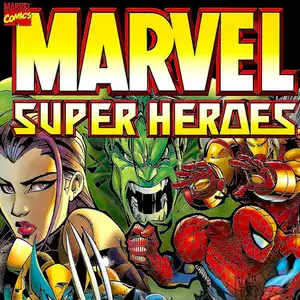
Marvel Super Heroes (MSH) is a fast 2D fighting game developed and published by Capcom, released for CPS2 arcade hardware in 1995. It is Capcom’s second Marvel fighting title, loosely adapted from the classic Marvel comic *Infinity Gauntlet*, and serves as the foundation for the later Marvel vs. Capcom franchise. Thanos seeks to collect all six Infinity Gems to rule the universe. Heroes and villains from across the Marvel universe fight to claim the gems and stop his cosmic scheme. Building upon the air-combo gameplay from X-Men: Children of the Atom, it uses a six-button layout (light/medium/heavy punch, light/medium/heavy kick). It features air dashes, aerial combos and super jumps. Fill the super combo gauge to unleash devastating Infinity Combo supers. Its landmark feature is the **six Infinity Gems system**. Gems drop when landing the first hit or when HP drops low. Activate a gem for temporary power-ups: Power boosts attack, Time raises movement speed, Space summons barriers, Reality grants super armor, Soul regenerates health, and Mind messes with enemy controls. Certain characters gain unique bonus effects when paired with specific gems, adding huge strategic variety. The base roster has 10 fighters: Spider-Man, Wolverine, Captain America, Iron Man, Hulk, Psylocke, Magneto, Blackheart, Juggernaut and Shuma-Gorath. Doctor Doom and Thanos appear as arcade bosses. The Japanese arcade version includes Anita from Darkstalkers as a secret playable character. Matches run best-of-three rounds, with single-player arcade mode and two-player versus mode. It features vibrant comic-book pixel art, flashy visual effects and satisfying hit feedback. It was popular among arcade players in China back then, and its innovative gem mechanic shaped the entire Marvel vs Capcom series.
- Année de sortie
- 1990
- Développeur
- Joueurs
- 2 joueurs
- Langues prises en charge
- English
FAQ
- Comment jouer à Marvel Super Heroes ?
- Vous pouvez jouer à Marvel Super Heroes en ligne et gratuitement directement dans votre navigateur sur 8BitGo. Aucun téléchargement ni installation d'émulateur n'est nécessaire.
- Sur quelle plateforme est Marvel Super Heroes ?
- 8BitGo classe cette version dans la catégorie Arcade. Cela décrit son mode d'exécution ici et peut différer de la plateforme de sortie d'origine. Vous pouvez jouer directement dans le navigateur.
- Puis-je sauvegarder ma progression dans Marvel Super Heroes ?
- La sauvegarde dépend du mode d'exécution du jeu. Les sauvegardes rapides et cloud ne sont disponibles que si la barre du lecteur affiche une commande de sauvegarde ; sinon, utilisez la sauvegarde intégrée au jeu.
- Marvel Super Heroes fonctionne-t-il sur mobile ?
- Cela dépend du jeu. Consultez les commandes sur cette page : les jeux avec boutons à l'écran fonctionnent au tactile, tandis que les jeux au clavier et à la souris sont mieux adaptés à un ordinateur.
Commandes
Voici les touches par défaut. Chaque carte d’arcade a un nombre de boutons différent et leur donne un sens différent. Les lignes ci-dessus sont les boutons 1 à 6 de la carte : sur Neo Geo (The King of Fighters et compagnie) A/B/C/D sont les boutons 1 à 4, Metal Slug n’utilise que 1, 2 et 4 (tir / saut / grenade), et Pac-Man n’en utilise aucun. Les jeux de combat à six boutons (trois poings, trois pieds — Street Fighter II par exemple) reçoivent une autre disposition du cœur : poing faible U, poing moyen I, poing fort Q, pied faible J, pied moyen K, pied fort E. Cliquez sur l’icône de manette 🎮 dans la barre du lecteur, puis sur « Redéfinir les touches » pour ouvrir les réglages de commandes de l’émulateur (clavier et manette, enregistrés automatiquement). Les manettes sont détectées automatiquement. Sur téléphone, des boutons virtuels s’affichent.
Croix directionnelle
W S A D
Bouton 1
J
Bouton 2
K
Bouton 3
U
Bouton 4
I
Bouton 5
E
Bouton 6
Q
Insérer une pièce
V
Start
Enter
Sauvegarde rapide
F2
Chargement rapide
F4
Tu aimeras peut-être aussi
Même plateforme, même genre, ou même développeur
 DOS
DOSAge of Empires
 NES
NESSuper Mario Bros.3
 NDS
NDSPlants vs. Zombies
 NES
NESCircus Charlie
 NES
NESGomoku Narabe Renju
 NDS
NDSGrand Theft Auto: Chinatown Wars
 GBA
GBAThe King of Fighters EX: Neo Blood
 ARCADE