
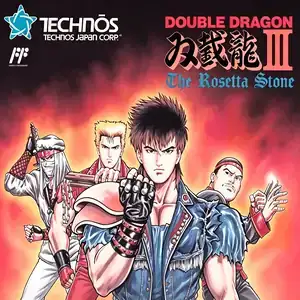
Vérification de la limite d’âge de ce jeu…
Double Dragon III: The Sacred Stones
À propos du jeu
Double Dragon III: The Sacred Stones (Japanese: ダブルドラゴン III ザ・ロゼッタストーン) is a side-scrolling beat 'em up developed by Technōs Japan and released for Famicom in 1991. It is not a direct port of the arcade counterpart but an original adaptation built exclusively for the Famicom, marking the finale of the Double Dragon trilogy on the console. A fortune teller named Hiruko tells Billy and Jimmy Lee that Marian has been kidnapped. To save her, they must collect three sacred Rosetta Stones scattered around the world. The Lee brothers embark on a global martial arts journey through five themed missions: USA, China, Japan, Italy and Egypt. Its landmark feature is recruitable boss characters. After defeating the Chinese fighter Chin Sei Mei and Japanese ninja Ranzou, they join your playable roster. The four playable characters have distinct stats: Chin hits hard while the ninja moves extremely fast. A new dash mechanic is added. The cyclone kick remains, but overpowered special moves such as flying knee and uppercut from the second game are removed. Each character has exclusive limited-use weapons including nunchucks, iron claws and shurikens. Two-player simultaneous co-op is retained. The health bar from DD2 is removed, returning to a limited life system, making the game noticeably harder. It has the best pixel visuals of the three Famicom Double Dragon games, with distinctive art for each country. The story has a major plot twist inside the Egyptian pyramid, revealing Hiruko’s deception. Widely distributed on Subor multicarts in China, its unique recruit mechanic and worldwide adventure make it a memorable, though divisive, classic Famicom brawler.
- Année de sortie
- 1990
- Développeur
- Joueurs
- 1 joueur
- Langues prises en charge
- 简体中文 · English
FAQ
- Comment jouer à Double Dragon III: The Sacred Stones ?
- Vous pouvez jouer à Double Dragon III: The Sacred Stones en ligne et gratuitement directement dans votre navigateur sur 8BitGo. Aucun téléchargement ni installation d'émulateur n'est nécessaire.
- Sur quelle plateforme est Double Dragon III: The Sacred Stones ?
- 8BitGo classe cette version dans la catégorie NES (Famicom). Cela décrit son mode d'exécution ici et peut différer de la plateforme de sortie d'origine. Vous pouvez jouer directement dans le navigateur.
- Puis-je sauvegarder ma progression dans Double Dragon III: The Sacred Stones ?
- La sauvegarde dépend du mode d'exécution du jeu. Les sauvegardes rapides et cloud ne sont disponibles que si la barre du lecteur affiche une commande de sauvegarde ; sinon, utilisez la sauvegarde intégrée au jeu.
- Double Dragon III: The Sacred Stones fonctionne-t-il sur mobile ?
- Cela dépend du jeu. Consultez les commandes sur cette page : les jeux avec boutons à l'écran fonctionnent au tactile, tandis que les jeux au clavier et à la souris sont mieux adaptés à un ordinateur.
Commandes
Voici les touches par défaut. Cliquez sur l’icône de manette 🎮 dans la barre du lecteur, puis sur « Redéfinir les touches » pour ouvrir les réglages de commandes de l’émulateur (clavier et manette, enregistrés automatiquement). Les manettes sont détectées automatiquement. Sur téléphone, des boutons virtuels s’affichent.
Croix directionnelle
W S A D
A
K
B
J
Start
Enter
Select
Shift
Sauvegarde rapide
F2
Chargement rapide
F4
Tu aimeras peut-être aussi
Même plateforme, même genre, ou même développeur
 DOS
DOSAge of Empires
 NES
NESSuper Mario Bros.3
 NDS
NDSPlants vs. Zombies
 NES
NESCircus Charlie
 NES
NESGomoku Narabe Renju
 NDS
NDSGrand Theft Auto: Chinatown Wars
 GBA
GBAThe King of Fighters EX: Neo Blood
 ARCADE