
Vérification de la limite d’âge de ce jeu…
Donkey Kong Jr.
À propos du jeu
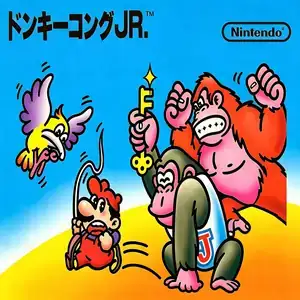
Donkey Kong Jr. (known to Chinese retro players as Donkey Kong 2) is developed by Nintendo R&D2 and released on July 15, 1983, as one of the three launch titles for Famicom. It is a port of the 1982 arcade original and the direct sequel to Donkey Kong. It is famous as the only mainline Nintendo game where Mario acts as the antagonist. The story reverses the original plot: Mario captures Donkey Kong and locks him inside a cage. Players control Donkey Kong’s son, Donkey Kong Jr., to overcome obstacles and rescue his father. Its signature gameplay focuses on vine climbing. Grab vines to move vertically; holding one vine lets you slide fast downward, while gripping two vines enables climbing upward. There are four fixed-screen stages: vine stage, springboard stage, chain stage and Mario’s hideout. Collect keys in the first three stages, then insert all keys into locks on the final stage to unlock the cage. Enemies include Snapjaw crocodiles, birds and electric sparks. You can knock fruits from treetops; falling fruits crush enemies below for bonus points. Two difficulty modes are available: Game A and harder Game B. Two players can take turns playing. You lose a life upon touching enemies, falling off platforms or when the bonus timer runs out. After beating all four stages, the game loops with increasing difficulty, and high score chasing is the main goal. It features simple graphics and unique climbing controls. Widely included on Subor multicarts in China, it is an iconic platformer from the Famicom launch era.
- Année de sortie
- 1990
- Développeur
- Joueurs
- 1 joueur
- Langues prises en charge
- 简体中文 · English · 日本語 · Español
FAQ
- Comment jouer à Donkey Kong Jr. ?
- Vous pouvez jouer à Donkey Kong Jr. en ligne et gratuitement directement dans votre navigateur sur 8BitGo. Aucun téléchargement ni installation d'émulateur n'est nécessaire.
- Sur quelle plateforme est Donkey Kong Jr. ?
- 8BitGo classe cette version dans la catégorie NES (Famicom). Cela décrit son mode d'exécution ici et peut différer de la plateforme de sortie d'origine. Vous pouvez jouer directement dans le navigateur.
- Puis-je sauvegarder ma progression dans Donkey Kong Jr. ?
- La sauvegarde dépend du mode d'exécution du jeu. Les sauvegardes rapides et cloud ne sont disponibles que si la barre du lecteur affiche une commande de sauvegarde ; sinon, utilisez la sauvegarde intégrée au jeu.
- Donkey Kong Jr. fonctionne-t-il sur mobile ?
- Cela dépend du jeu. Consultez les commandes sur cette page : les jeux avec boutons à l'écran fonctionnent au tactile, tandis que les jeux au clavier et à la souris sont mieux adaptés à un ordinateur.
Commandes
Voici les touches par défaut. Cliquez sur l’icône de manette 🎮 dans la barre du lecteur, puis sur « Redéfinir les touches » pour ouvrir les réglages de commandes de l’émulateur (clavier et manette, enregistrés automatiquement). Les manettes sont détectées automatiquement. Sur téléphone, des boutons virtuels s’affichent.
Croix directionnelle
W S A D
A
K
B
J
Start
Enter
Select
Shift
Sauvegarde rapide
F2
Chargement rapide
F4
Tu aimeras peut-être aussi
Même plateforme, même genre, ou même développeur
 DOS
DOSAge of Empires
 NES
NESSuper Mario Bros.3
 NDS
NDSPlants vs. Zombies
 NES
NESCircus Charlie
 NES
NESGomoku Narabe Renju
 NDS
NDSGrand Theft Auto: Chinatown Wars
 GBA
GBAThe King of Fighters EX: Neo Blood
 ARCADE