
Vérification de la limite d’âge de ce jeu…
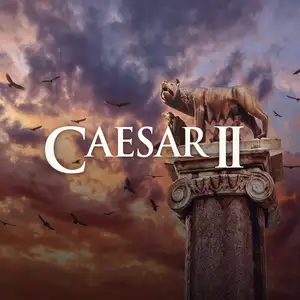
Caesar II
À propos du jeu
Caesar II is an ancient Roman city-building simulation developed by Impressions Games and published by Sierra On-Line, released for MS-DOS in 1995. It is the second entry of the Caesar franchise, greatly upgrading graphics and gameplay over the original Caesar 1. Players act as Roman provincial governors. Your goal is to govern provinces, build prosperous cities, gain the emperor’s favor, climb the ranks, and ultimately become Caesar. It retains the two-map system: province overworld and city detail view. On the province map, you build farms, mines, ports and forts, establish trade routes and manage resource production and border defense. Inside the city, construct housing, aqueducts, bathhouses, markets, temples and amphitheaters. Unlike Caesar III, it does not use walker mechanics; service coverage is calculated purely by building distance. Cities are evaluated by four key metrics: population, food supply, taxation, security and cultural prosperity. You must complete imperial assignments and tribute requests from the emperor. A new AI rival competes with you for provinces and imperial approval, seizing undeveloped lands and adding competitive pressure. Barbarian armies launch raids from their settlements. Build city walls and forts, recruit Roman legions and fight in standalone tactical battles to defend your territory. As provinces are civilized, new territories unlock. Your campaign begins in Italy and expands to the full extent of the Roman Empire. It uses isometric graphics built from pre-rendered 3D assets with vastly improved building details and majestic soundtrack, supporting Sound Blaster audio. The game is single-player campaign only, with no free sandbox mode. It refined the predecessor’s three-in-one gameplay loop combining city construction, provincial management and tactical warfare, laying the foundation for Caesar III. Modern players run it with DOSBox emulator. It is a landmark historical strategy simulation DOS title of the 1990s.
- Année de sortie
- 1990
- Développeur
- Joueurs
- 1 joueur
- Langues prises en charge
- English
FAQ
- Comment jouer à Caesar II ?
- Vous pouvez jouer à Caesar II en ligne et gratuitement directement dans votre navigateur sur 8BitGo. Aucun téléchargement ni installation d'émulateur n'est nécessaire.
- Sur quelle plateforme est Caesar II ?
- 8BitGo classe cette version dans la catégorie Jeux PC DOS. Cela décrit son mode d'exécution ici et peut différer de la plateforme de sortie d'origine. Vous pouvez jouer directement dans le navigateur.
- Puis-je sauvegarder ma progression dans Caesar II ?
- La sauvegarde dépend du mode d'exécution du jeu. Les sauvegardes rapides et cloud ne sont disponibles que si la barre du lecteur affiche une commande de sauvegarde ; sinon, utilisez la sauvegarde intégrée au jeu.
- Caesar II fonctionne-t-il sur mobile ?
- Cela dépend du jeu. Consultez les commandes sur cette page : les jeux avec boutons à l'écran fonctionnent au tactile, tandis que les jeux au clavier et à la souris sont mieux adaptés à un ordinateur.
Commandes
Ces jeux reçoivent le clavier directement : les touches sont celles que le jeu définit lui-même, en général dans son écran d’aide ou d’options. Les manettes sont détectées automatiquement. Sur téléphone, des boutons virtuels s’affichent.
Tu aimeras peut-être aussi
Même plateforme, même genre, ou même développeur
 DOS
DOSAge of Empires
 NES
NESSuper Mario Bros.3
 NDS
NDSPlants vs. Zombies
 NES
NESCircus Charlie
 NES
NESGomoku Narabe Renju
 NDS
NDSGrand Theft Auto: Chinatown Wars
 GBA
GBAThe King of Fighters EX: Neo Blood
 ARCADE